What Is the Probability That a Randomly Selected Eight-week Baby Smiles Between 2 and 18 Seconds
Probability
Probability defines the likelihood of occurrence of an upshot. There are many existent-life situations in which nosotros may accept to predict the outcome of an issue. We may exist sure or not sure of the results of an event. In such cases, nosotros say that there is a probability of this result to occur or not occur. Probability generally has cracking applications in games, in concern to make probability-based predictions, and too probability has all-encompassing applications in this new expanse of artificial intelligence.
The probability of an upshot tin can be calculated past probability formula by merely dividing the favorable number of outcomes past the total number of possible outcomes. The value of the probability of an event to happen can lie between 0 and 1 because the favorable number of outcomes tin can never cross the total number of outcomes. Also, the favorable number of outcomes cannot be negative. Let united states of america discuss the basics of probability in item in the post-obit sections.
| ane. | What is Probability? |
| 2. | Terminology of Probability Theory |
| 3. | Probability Formula |
| four. | Probability Tree Diagram |
| v. | Types of Probability |
| 6. | Finding the Probability of an Effect |
| vii. | Coin Toss Probability |
| 8. | Die Whorl Probability |
| ix. | Probability of Drawing Cards |
| 10. | Theorems on Probability |
| 11. | FAQs on Probability |
What is Probability?
Probability can exist divers equally the ratio of the number of favorable outcomes to the full number of outcomes of an consequence. For an experiment having 'n' number of outcomes, the number of favorable outcomes can be denoted by x. The formula to calculate the probability of an event is as follows.
Probability(Event) = Favorable Outcomes/Total Outcomes = x/n
Allow united states of america cheque a simple awarding of probability to understand information technology better. Suppose we have to predict about the happening of rain or not. The answer to this question is either "Yes" or "No". There is a likelihood to rain or not rain. Here we tin can apply probability. Probability is used to predict the outcomes for the tossing of coins, rolling of die, or drawing a carte du jour from a pack of playing cards.
The probability is classified into theoretical probability and experimental probability.
Terminology of Probability Theory
The following terms in probability help in a better understanding of the concepts of probability.
Experiment: A trial or an functioning conducted to produce an outcome is chosen an experiment.
Sample Space: All the possible outcomes of an experiment together constitute a sample space. For example, the sample space of tossing a coin is head and tail.
Favorable Outcome: An issue that has produced the desired result or expected event is chosen a favorable outcome. For case, when we whorl two die, the possible/favorable outcomes of getting the sum of numbers on the two dice equally 4 are (one,3), (2,2), and (3,1).
Trial: A trial denotes doing a random experiment.
Random Experiment: An experiment that has a well-divers gear up of outcomes is called a random experiment. For case, when we toss a coin, nosotros know that we would become ahead or tail, simply we are not sure which one volition appear.
Event: The total number of outcomes of a random experiment is called an effect.
Equally Probable Events: Events that take the same chances or probability of occurring are called as likely events. The effect of one consequence is independent of the other. For instance, when nosotros toss a coin, at that place are equal chances of getting a head or a tail.
Exhaustive Events: When the prepare of all outcomes of an experiment is equal to the sample space, we call it an exhaustive issue.
Mutually Exclusive Events: Events that cannot happen simultaneously are called mutually exclusive events. For instance, the climate can be either hot or cold. We cannot experience the same weather simultaneously.
Probability Formula
The probability formula defines the likelihood of the happening of an effect. It is the ratio of favorable outcomes to the full favorable outcomes. The probability formula tin be expressed as,
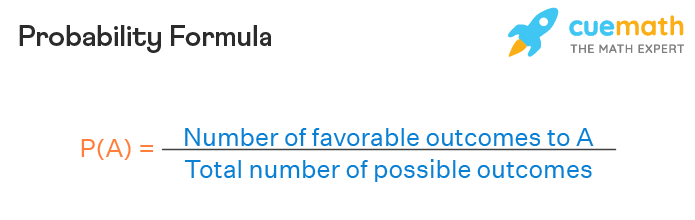
where,
- P(B) is the probability of an event 'B'.
- n(B) is the number of favorable outcomes of an event 'B'.
- n(S) is the total number of events occurring in a sample space.
Different Probability Formulas
Probability formula with addition rule: Whenever an event is the spousal relationship of two other events, say A and B, then
P(A or B) = P(A) + P(B) - P(A∩B)
P(A ∪ B) = P(A) + P(B) - P(A∩B)
Probability formula with the complementary rule: Whenever an event is the complement of another event, specifically, if A is an event, then P(not A) = 1 - P(A) or P(A') = 1 - P(A).
P(A) + P(A′) = 1.
Probability formula with the provisional rule: When event A is already known to take occurred and the probability of event B is desired, then P(B, given A) = P(A and B), P(A, given B). It tin can be vice versa in the instance of issue B.
P(B∣A) = P(A∩B)/P(A)
Probability formula with multiplication rule: Whenever an event is the intersection of 2 other events, that is, events A and B need to occur simultaneously. Then P(A and B) = P(A)⋅P(B).
P(A∩B) = P(A)⋅P(B∣A)
Instance 1: Find the probability of getting a number less than 5 when a die is rolled by using the probability formula.
Solution
To find:
Probability of getting a number less than 5
Given: Sample space = {i,two,3,4,5,6}
Getting a number less than 5 = {one,2,3,iv}
Therefore, n(S) = 6
n(A) = four
Using Probability Formula,
P(A) = (n(A))/(n(s))
p(A) = 4/vi
one thousand = 2/3
Reply: The probability of getting a number less than five is two/3.
Instance two: What is the probability of getting a sum of 9 when two dice are thrown?
Solution:
There is a total of 36 possibilities when we throw two die.
To become the desired outcome i.east., nine, we can have the following favorable outcomes.
(4,5),(v,4),(half dozen,3)(iii,vi). There are iv favorable outcomes.
Probability of an event P(Due east) = (Number of favorable outcomes) ÷ (Full outcomes in a sample infinite)
Probability of getting number ix = 4 ÷ 36 = 1/9
Answer: Therefore the probability of getting a sum of nine is 1/nine.
Probability Tree Diagram
A tree diagram in probability is a visual representation that helps in finding the possible outcomes or the probability of any event occurring or not occurring. The tree diagram for the toss of a coin given below helps in understanding the possible outcomes when a coin is tossed and thus in finding the probability of getting a head or tail when a money is tossed.

Types of Probability
There can exist unlike perspectives or types of probabilities based on the nature of the outcome or the arroyo followed while finding the probability of an outcome happening. The four types of probabilities are,
- Classical Probability
- Empirical Probability
- Subjective Probability
- Evident Probability
Classical Probability
Classical probability, often referred to as the "priori" or "theoretical probability", states that in an experiment where at that place are B equally probable outcomes, and event X has exactly A of these outcomes, and then the probability of X is A/B, or P(X) = A/B. For example, when a fair die is rolled, at that place are six possible outcomes that are equally likely. That means, there is a 1/half dozen probability of rolling each number on the dice.
Empirical Probability
The empirical probability or the experimental perspective evaluates probability through thought experiments. For example, if a weighted die is rolled, such that we don't know which side has the weight, and then nosotros tin get an thought for the probability of each outcome by rolling the dice number of times and calculating the proportion of times the die gives that issue and thus find the probability of that outcome.
Subjective Probability
Subjective probability considers an individual'south own belief of an event occurring. For example, the probability of a particular team winning a football game match on a fan'southward opinion is more dependent upon their own belief and feeling and not on a formal mathematical calculation.
Axiomatic Probability
In axiomatic probability, a ready of rules or axioms by Kolmogorov are applied to all the types. The chances of occurrence or not-occurrence of whatever event can be quantified by the applications of these axioms, given as,
- The smallest possible probability is nothing, and the largest is 1.
- An event that is sure has a probability equal to one.
- Whatever two mutually exclusive events cannot occur simultaneously, while the union of events says simply ane of them tin can occur.
Finding the Probability of an Event
In an experiment, the probability of an issue is the possibility of that event occurring. The probability of any event is a value between (and including) "0" and "ane".
Events in Probability
In probability theory, an consequence is a set of outcomes of an experiment or a subset of the sample space.
If P(E) represents the probability of an event E, then, we have,
- P(Eastward) = 0 if and only if Due east is an impossible consequence.
- P(E) = 1 if and only if Due east is a certain event.
- 0 ≤ P(E) ≤ one.
Suppose, we are given two events, "A" and "B", so the probability of upshot A, P(A) > P(B) if and merely if upshot "A" is more than probable to occur than the consequence "B". Sample space(S) is the set of all of the possible outcomes of an experiment and n(Due south) represents the number of outcomes in the sample space.
P(E) = north(E)/due north(Due south)
P(East') = (n(S) - n(E))/north(S) = ane - (northward(E)/n(Due south))
E' represents that the event will not occur.
Therefore, now we can also conclude that, P(E) + P(E') = one
Money Toss Probability
Permit united states of america at present wait into the probability of tossing a coin. Quite often in games like cricket, for making a decision as to who would bowl or bat offset, nosotros sometimes employ the tossing of a money and decide based on the result of the toss. Permit us check as to how we can use the concept of probability in the tossing of a single coin. Farther, we shall also await into the tossing of ii and three coming respectively.
Tossing a Money
A single coin on tossing has two outcomes, a head, and a tail. The concept of probability which is the ratio of favorable outcomes to the total number of outcomes tin exist used to find the probability of getting the caput and the probability of getting a tail.
Full number of possible outcomes = 2; Sample Space = {H, T}; H: Head, T: Tail
- P(H) = Number of heads/Total outcomes = 1/2
- P(T)= Number of Tails/ Total outcomes = 1/2
Tossing Ii Coins
In the process of tossing two coins, nosotros have a total of iv outcomes. The probability formula tin can be used to discover the probability of two heads, i caput, no head, and a similar probability tin exist calculated for the number of tails. The probability calculations for the ii heads are as follows.
Total number of outcomes = four; Sample Space = {(H, H), (H, T), (T, H), (T, T)}
- P(2H) = P(0 T) = Number of result with ii heads/Full Outcomes = 1/4
- P(1H) = P(1T) = Number of outcomes with only i caput/Total Outcomes = 2/four = 1/2
- P(0H) = (2T) = Number of effect with two heads/Total Outcomes = 1/4
Tossing Three Coins
The number of total outcomes on tossing iii coins simultaneously is equal to two3 = viii. For these outcomes, we tin find the probability of getting ane head, 2 heads, three heads, and no caput. A similar probability tin likewise be calculated for the number of tails.
Total number of outcomes = 23 = 8 Sample Infinite = {(H, H, H), (H, H, T), (H, T, H), (T, H, H), (T, T, H), (T, H, T), (H, T, T), (T, T, T)}
- P(0H) = P(3T) = Number of outcomes with no heads/Total Outcomes = 1/8
- P(1H) = P(2T) = Number of Outcomes with 1 head/Total Outcomes = 3/8
- P(2H) = P(1T) = Number of outcomes with two heads /Full Outcomes = 3/8
- P(3H) = P(0T) = Number of outcomes with three heads/Full Outcomes = i/8
Die Curlicue Probability
Many games use dice to make up one's mind the moves of players across the games. A die has six possible outcomes and the outcomes of a dice is a game of chance and tin be obtained by using the concepts of probability. Some games also employ 2 die, and there are numerous probabilities that can be calculated for outcomes using two die. Let us at present check the outcomes, their probabilities for one dice and ii dice respectively.
Rolling One Dice
The total number of outcomes on rolling a die is half-dozen, and the sample space is {1, 2, 3, 4, 5, 6}. Here we shall compute the following few probabilities to help in better understanding the concept of probability on rolling one dice.
- P(Even Number) = Number of even number outcomes/Total Outcomes = iii/half-dozen = 1/ii
- P(Odd Number) = Number of odd number outcomes/Total Outcomes = iii/vi = ane/ii
- P(Prime) = Number of prime number outcomes/Total Outcomes = iii/six = ane/2
Rolling Two Dice
The full number of outcomes on rolling 2 die is 62 = 36. The following image shows the sample space of 36 outcomes on rolling two dice.

Let united states check a few probabilities of the outcomes from two die. The probabilities are every bit follows.
- Probability of getting a doublet(Same number) = 6/36 = ane/vi
- Probability of getting a number 3 on at to the lowest degree one dice = 11/36
- Probability of getting a sum of 7 = six/36 = i/6
As we run across, when we roll a single dice, in that location are six possibilities. When we roll two dice, in that location are 36 possibilities. When nosotros roll 3 dice nosotros get 216 possibilities. So a general formula to stand for the number of outcomes on rolling 'n' dice is sixn.
Probability of Drawing Cards
A deck containing 52 cards is grouped into 4 suits of clubs, diamonds, hearts, and spades. Each of the clubs, diamonds, hearts, and spades accept thirteen cards each, which sum up to 52. Now let us discuss the probability of drawing cards from a pack. The symbols on the cards are shown below. Spades and clubs are blackness cards. Hearts and diamonds are ruddy cards.

The 13 cards in each suit are ace, 2, 3, 4, 5, six, vii, 8, ix, x, jack, queen, king. In these, the jack, the queen, and the king are called face cards. Nosotros tin can understand the carte du jour probability from the following examples.
- The probability of drawing a blackness card is P(Black bill of fare) = 26/52 = one/2
- The probability of drawing a hearts card is P(Hearts) = xiii/52 = ane/4
- The probability of cartoon a face card is P(Face carte du jour) = 12/52 = three/xiii
- The probability of drawing a card numbered four is P(4) = 4/52 = 1/13
- The probability of drawing a red card numbered 4 is P(iv Ruddy) = ii/52 = 1/26
Probability Theorems
The post-obit theorems of probability are helpful to understand the applications of probability and as well perform the numerous calculations involving probability.
Theorem one: The sum of the probability of happening of an result and non happening of an issue is equal to one. \(P(A) + P(\bar A) = ane\)
Theorem ii: The probability of an impossible event or the probability of an event not happening is always equal to 0. \(\begin{align}P(\phi) =0\terminate{align}\)
Theorem 3: The probability of a sure result is always equal to ane. P(A) = 1
Theorem 4: The probability of happening of any effect ever lies between 0 and 1. 0 < P(A) < 1
Theorem v: If there are two events A and B, we can utilise the formula of the union of two sets and we tin can derive the formula for the probability of happening of upshot A or event B as follows.
\(P(A\cup B) = P(A) + P(B) - P(A\cap B)\)
Also for two mutually exclusive events A and B, we have P( A U B) = P(A) + P(B)
Bayes' Theorem on Conditional Probability
Bayes' theorem describes the probability of an event based on the status of occurrence of other events. It is as well called provisional probability. Information technology helps in calculating the probability of happening of one issue based on the status of happening of another upshot.
For example, let us presume that in that location are 3 bags with each bag containing some blue, green, and yellow assurance. What is the probability of picking a yellow ball from the third purse? Since there are blue and green colored balls besides, we can get in at the probability based on these conditions also. Such a probability is called conditional probability.
The formula for Bayes' theorem is \(\begin{marshal}P(A|B) = \dfrac{ P(B|A)·P(A)} {P(B)}\stop{align}\)
where, \(\begin{align}P(A|B) \stop{align}\) denotes how often event A happens on a condition that B happens.
where, \(\brainstorm{marshal}P(B|A) \finish{align}\) denotes how often event B happens on a status that A happens.
\(\begin{align}P(A) \end{align}\) the likelihood of occurrence of effect A.
\(\brainstorm{align}P(B) \stop{align}\) the likelihood of occurrence of effect B.
Police force of Total Probability
If there are n number of events in an experiment, then the sum of the probabilities of those n events is always equal to ane.
\(P(A_1) + P(A_2) + P(A_3) + ....P(A_n) = i\)
☛ Also Check:
- Probability and Statistics
- Probability Rules
- Mutually Sectional Events
- Contained Events
- Binomial Distribution
- Baye'south Formula
- Poisson Distribution Formula
Of import Notes on Probability:
Let united states of america check the below points, which help us summarize the key learnings for this topic of probability.
- Probability is a measure of how likely an event is to happen.
- Probability is represented as a fraction and always lies between 0 and 1.
- An result can be defined equally a subset of sample space.
- The outcome of throwing a money is a head or a tail and the upshot of throwing die is one, 2, iii, 4, 5, or 6.
- A random experiment cannot predict the verbal outcomes only just some likely outcomes.
Solved Examples on Probability
go to slidego to slidego to slidego to slide

Breakup tough concepts through simple visuals.
Math will no longer be a tough subject, especially when y'all understand the concepts through visualizations.
Book a Free Trial Form
Practice Questions on Probability
go to slidego to slide
FAQs on Probability
What is Probability?
Probability is a branch of math which deals with finding out the likelihood of the occurrence of an event. Probability measures the chance of an outcome happening and is equal to the number of favorable events divided by the total number of events. The value of probability ranges between 0 and 1, where 0 denotes dubiousness and 1 denotes certainty.
How To Calculate Probability Using the Probability Formula?
The probability of whatever event depends upon the number of favorable outcomes and the total outcomes. In full general, the probability is the ratio of the number of favorable outcomes to the total outcomes in that sample space. It is expressed equally, Probability of an event P(E) = (Number of favorable outcomes) ÷ (Sample space).
How to Decide Probability?
The probability can be adamant by starting time knowing the sample space of outcomes of an experiment. A probability is generally calculated for an result (x) within the sample space. The probability of an consequence happening is obtained past dividing the number of outcomes of an upshot past the total number of possible outcomes or sample infinite.
What are the Three Types of Probability?
The three types of probabilities are theoretical probability, experimental probability, and evident probability. The theoretical probability calculates the probability based on formulas and input values. The experimental probability gives a realistic value and is based on the experimental values for calculation. Quite often the theoretical and experimental probability differ in their results. And the evident probability is based on the axioms which govern the concepts of probability.
What is Conditional Probability?
The conditional probability predicts the happening of one effect based on the happening of another event. If there are two events A and B, provisional probability is a chance of occurrence of event B provided the event A has already occurred. The formula for the conditional probability of happening of event B, given that issue A, has happened is P(B/A) = P(A ∩ B)/P(A).
What is Experimental Probability?
The experimental probability is based on the results and the values obtained from the probability experiments. Experimental probability is defined as the ratio of the total number of times an event has occurred to the total number of trials conducted. The results of the experimental probability are based on real-life instances and may differ in values from theoretical probability.
What is a Probability Distribution?
The two important probability distributions are binomial distribution and Poisson distribution. The binomial distribution is divers for events with two probability outcomes and for events with a multiple number of times of such events. The Poisson distribution is based on the numerous probability outcomes in a limited space of time, distance, sample infinite. An case of the binomial distribution is the tossing of a money with two outcomes, and for conducting such a tossing experiment with north number of coins. A Poisson distribution is for events such equally antigen detection in a plasma sample, where the probabilities are numerous.
How are Probability and Statistics Related?
The probability calculates the happening of an experiment and it calculates the happening of a detail result with respect to the entire set of events. For simple events of a few numbers of events, it is piece of cake to calculate the probability. But for calculating probabilities involving numerous events and to manage huge information relating to those events nosotros demand the help of statistics. Statistics helps in rightly analyzing
How Probability is Used in Real Life?
Probability has huge applications in games and analysis. Besides in real life and industry areas where it is about prediction we make employ of probability. The prediction of the price of a stock, or the performance of a team in cricket requires the employ of probability concepts. Further, the new applied science field of bogus intelligence is extensively based on probability.
How was Probability Discovered?
The utilize of the word probable started outset in the seventeenth century when it was referred to actions or opinions which were held by sensible people. Farther, the word probable in the legal content was referred to a proposition that had tangible proof. The field of permutations and combinations, statistical inference, cryptoanalysis, frequency analysis take altogether contributed to this current field of probability.
Where Do We Use the Probability Formula In Our Real Life?
The following activities in our real-life tend to follow the probability formula:
- Conditions forecasting
- Playing cards
- Voting strategy in politics
- Rolling a dice.
- Pulling out the verbal matching socks of the same colour
- Chances of winning or losing in any sports.
What is the Conditional Probability Formula?
The conditional probability depends upon the happening of 1 event based on the happening of some other consequence. The provisional probability formula of happening of event B, given that consequence A, has already happened is expressed as P(B/A) = P(A ∩ B)/P(A).
sheppardvoure1995.blogspot.com
Source: https://www.cuemath.com/data/probability/
0 Response to "What Is the Probability That a Randomly Selected Eight-week Baby Smiles Between 2 and 18 Seconds"
Postar um comentário