Modern Wing of Art Institute Chicago Frank Lloyd Wright
The Prairie Style: From Theory to Practice
Although Frank Lloyd Wright designed houses, churches, and commercial buildings in differing styles, he is probably most associated with the Prairie Style, which dates from approximately 1893 to the Showtime World War.
It seemed to embody his most significant philosophical ideas about architecture and brought him both national and international acclaim past the time he was forty.
Neil Levine, in The Architecture of Frank Lloyd Wright (Princeton: Princeton UP, 1996), attributes the impetus of the Prairie Schoolhouse to Chicago builder LouisH. Sullivan, with whom Wright worked before establishing his own studio. The grouping included, amid others, Dwight Perkins, Myron Hunt, and Robert Spencer—all housed on an upper flooring of Steinway Hall. They worked mainly for heart- to upper-eye-class clients in suburban Chicago, notably Oak Park, rural Illinois, Minnesota, Iowa, and Wisconsin. Their work "was a regional revolt and reform then occurring in the visual arts," notes H. Allen Brooks (The Prairie Schoolhouse: Frank Lloyd Wright and His Midwest Contemporaries [NY: Norton, 1972]: 4).
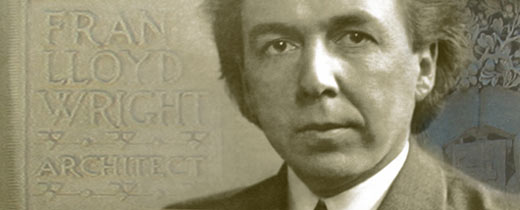
"Nature was Wright's constant preoccupation," says Levine (xvii). Wright gained an appreciation for nature, particularly Midwestern nature, from working on his uncles' Wisconsin farm during his teenage summers. There he could observe the horizontal line of the land, the line that he considered domestic and democratic and freeing. "On the flat prairie of the Midwest, breadth would be a sign of shelter, equally height was a sign of power and success in the metropolis" (17). Information technology would signify condolement, a quality that Wright wanted to characterize his buildings, particularly his houses.
To this end Wright'south Prairie Manner house typically features a large, centrally-placed fireplace, a hearth that "grounds" the firm, that becomes its focus. Frequently he designed benches on either side of information technology, as he did for the Westcott Business firm here in Springfield, Ohio, in result creating a room within a room. In at to the lowest degree one example he elevated this space from the residual of the surface area and set it off by a series of arches.
The Winslow Business firm in River Forest, Illinois, built in 1893-94, typifies the Prairie Business firm. It fix the standard. In fact, Wright himself called it "the starting time 'prairie house'" (14). Like to the later Westcott House, it, as well, was sited back from the street on an elevated spot and featured a reflecting puddle on a terrace, tawny colored Roman brick, and a deep overhang of hip roof. "In the Winslow House," says Levine, "the formal equation of hearth and abode became a fundamental element of the Prairie Firm type, transmitting the emotional content of the type through the very cadre of the edifice" (19).
Building materials of Prairie Style homes were unproblematic: plaster (stucco), wood, and brick. According to Henry-Russell Hitchcock, near all masonry houses stood on open, prairie sites, while wooden and brick ones were typically suburban (In the Nature of Materials: The Buildings of Frank Lloyd Wright 1887-1941 [New York: DaCapo, 1942], 39). Although Wright departed from members of the Craft Movement past approving use of the machine, he fabricated relatively little utilize of electric current engineering innovations; however, upon occasion he did include steel beams. Ornamentation on his houses (except for leaded glass) was likewise rare. Instead he depended for involvement upon juxtaposed shapes and forms, for example, horizontal bands of windows, as displayed in the Westcott House.
H. Allen Brooks, writing in Frank Lloyd Wright and the Prairie School (NY: Braziller, 1984), emphasizes the American-ness of the Prairie Manner, given its "theoretical connectedness with nature, the design process being derived from natural laws rather than philosophical idealism or classical rules" (9). Wright and other members of the Prairie School believed that the blueprint should adapt perfectly to office. "The artistic process was 'organic,' unfolding or growing from the inside out, establishing integral relationships betwixt plan and top, interior infinite and external expression, compages and decoration" (10).
Furthermore, they believed that the relationship between the building and its landscape should be close; i.eastward., a firm should blend into its setting. Therefore, they used materials indigenous to the Midwest: e.g., pino, oak, and limestone. They left exterior woodwork unplanned and unpainted (but stained). They stained and waxed interior woodwork (ten).
Noteworthy to the Prairie Style was the openness of both interior and outside spaces. Rooms became fewer in number than those in previous architectural styles merely more than flexible in utilise. Instead of having several rooms each with its own purpose, the chief room of the Westcott House, for example, is an open space extending sixty feet. Portions were used as a living room, a dining room, and a library. In other words, the interior spaces were not enclosed in the traditional sense. Wright believed that this multi-purposed approach to living areas made the house seem larger and more relaxed. When he did employ dividers, they were usually piers or screens rather than walls.
This unified approach to pattern meant that Wright wanted the furnishings of a house integrated into the total design plan. He created formal, slat-back chairs, window glass, lite fixtures, rugs, prc—aiming for artistic harmony (20). Generally each set of furniture, lighter than that of the Arts and Crafts Movement, was unique to its building.
"What is about striking near [Prairie School architects'] piece of work is its optimism and genuine sense of purpose—a spirit which is characteristic of much of the new architecture at the turn of the century—and its hostage moral tone, perchance best described by the dual imperative that their piece of work be both 'unproblematic' and 'honest.' Theirs was a fundamentally American approach, although ane based on principles that were recognized and applauded far beyond our borders," comments Brooks (7).
In Wasmuth Portfolio (Berlin, 1910), Wright articulates his goal in this mode: "To thus make of a dwelling house place a consummate piece of work of art, in itself equally expressive and beautiful and more intimately related to life than anything of detached sculpture or painting, lending itself freely and suitably to the private needs of the dwellers, an harmonious entity, plumbing fixtures in color, pattern and nature the utilities, and in itself really an expression of them in grapheme—this is the modernistic American opportunity" (16).
Although other Prairie Schoolhouse architects overshadowed Wright afterwards 1909, the Prairie Style had a significant touch upon the Us, Europe, and Australia. (The ranch style homes of the 1950s and 1960s illustrate its revival.) Says Brooks, "The buildings of the Prairie Schoolhouse, in spite of their international impact and continuing influence, were very respectful of their own time and place and very much American. They were not fanciful inventions for the sake of being different, but rather combined the best ideas, both from high art and the vernacular, that American architecture had to offering. Responsive to the lessons (and romanticism) of nature, and to the modernity of the machine, these buildings, the many hundreds of them, take more than stood the test of time and continue their useful service with little or no need of modification. Nestling quietly into the landscape, where they seem to vest, they enrich the quality of life for all who know them, and exit united states with an abundant inheritance of ideas and principles for the future" (27).
Frank Lloyd Wright in Ohio
Completed in 1908, the Westcott Firm is the earliest Wright-designed house congenital in Ohio. In the 1930s, Wright decided to design houses for the middle course-Usonian houses, he called them. These were generally smaller, one-story, sometimes, with wings sprouting from the main department. Like their Prairie Style forebears, all the same, they, also, were designed with multi-purpose spaces and with an accent upon nature. The house and the environment were to go 1.
The Charles Weltzheimer residence, congenital in Oberlin in 1948, is the just Usonian house in Ohio open to the public. It has an L-shape, with the bedroom wing set at a right angle to the combined living and dining areas. The southern side of the flat-roofed business firm has clerestory windows that seem to produce a glass wall. Furniture, cabinetry and lighting are built in. The exterior features reddish wooden croquet balls decorating the fascia and curved cutouts on clerestory panels. The Weltzheimer/Johnson House is now owned by Oberlin College equally part of the Allen Memorial Art Museum.
When in 1951 the Cleveland Manifestly Dealer ran an commodity about the Weltzheimer Firm, information technology inspired Canton residents Nathan Rubin and his wife to visit. They fell in honey with the house, and deputed Wright to design one for them. Built in 1951, Wright originally designed it for a group of Usonian homes in Okemos, Mich. It is long and low with brick and horizontal forest siding. Wings protrude at 120-degree angles from the main section of the house.
Nathan Rubin is related past marriage to Ellis A. Feiman, who commissioned Wright to design a house for him 3 years later. Located only 1 block from the Rubin House, the large, brick Feiman House features an exterior brick wall with T-shaped cutouts.
The third Frank Lloyd Wright house in County, the John J. Dobkins House, besides dates to 1954. Located further east than the Rubin and Feiman houses, it is prepare back from the road, has tall, thin casement doors and prominent windows that rise to nearly the roofline.
Another Wright holding in Ohio open to the public is the Louis Penfield House in Willoughby Hills. Situated east of Cleveland on the Chagrin River, information technology is available for weekend and holiday rental. Different from many other houses that Wright designed, the Penfield House has doors that reach a normal meridian—six feet eight inches. Although Wright himself was brusque and preferred his structures close to the ground, he accommodated the needs of Penfield, who reportedly stood taller than six anxiety. Wright raised some ceilings to viii feet as well. The three-bedchamber Penfield Business firm is Wrightian in its use of narrow doors and stairways. Ribbon windows and vertical beams assistance to make the concrete block and woods structure seem larger than it is. The living room features built-in furniture. For more information about the Penfield House, visit www.penfieldhouse.com.
The Cincinnati surface area boasts three Wright backdrop, the Cedric Yard. Boulter, William Boswell and Gerald B. Tonkens houses. The Boulter Firm sits on a corner well-nigh the Gaslight District, close to the University of Cincinnati. The house was completed in 1956. Wright designed an improver for it in 1958, one year before he died. Its carport was enclosed in 1990.
The Boswell House, from 1957, is located in Indian Colina. It is the final known Usonian house built in Ohio. Thrust into the side of a hill, information technology seems invisible except in winter. This big structure houses an open up living room with glass on three sides, the windows facing the woods. At each side of the living room are the dining room and the private study. 2 long wings come off the primary infinite. Service rooms extend down one wing: kitchen, breakfast nook, laundry, bath, tool room, servants' quarters and spacious playroom. The other wing includes the master bedroom suite and bathroom, walk-in cupboard and dressing room, five smaller bedrooms and ii baths. The Boswell House was completed in 1961, 2 years after Wright's death, nether the supervision of Taliesin architects.
The Tonkens House, dating to 1955, is located in Amberley Village. Information technology boasts a roof of solid coffered concrete block. The dwelling house is distinctive because of the gold foliage on the hall ceiling that leads from the entry to the bedroom wing.
Ane other pregnant Ohio Frank Lloyd Wright destination is the Kenneth L. Meyers Medical Dispensary in Dayton. Currently called the Plastic Surgery Pavilion, information technology serves every bit the clinic of Dr. James Apesos and features a round laboratory in the center of the medical section. Sited on a big tract of land back from the street, the construction appears to rise from the earth. This long, low brick building is imposing, with bands of windows that meet at the corners. Eaves are broad, and a depression entry leads to the high space of the main room. Once more a large hearth—the center of many Wright designs—offers welcome. Demote seating based on Wright'south plan was added in 1989, so were two large tables. (The dispensary dates to 1956.) Dr. Apesos has been conscientious to adhere to Wright's influence in other appointments too, such every bit a narrow terrace of ruby-dyed concrete that echoes the color of the brick.
Frank Lloyd Wright - Wright in Japan
The post-obit overview is past Karen Severns, a founding trustee of Wrightian Architectural Archives Japan (WAAJ) and the author-director of Magnificent Obsession: Frank Lloyd Wright's Buildings and Legacy in Japan.
Frank Lloyd Wright's fascination with Nihon began with ukiyo-e woodblock prints in the late 1880s and spanned his entire lifetime. When the 37-year-old builder made his very first trip outside America, in 1905, it was not to Europe — that mecca of Western architecture — but to Nihon. With his wife Catherine and another couple, he spent two months touring natural and historical landmarks from Nikko all the way down to Takamatsu. Wright was able to maintain his idealized paradigm of Erstwhile Japan throughout the visit, despite the country'south wholesale rush to modernize, calling it "the virtually romantic, nigh beautiful" nation on globe.
Wright always credited Nihon'southward arts, and not its architecture, with inspiring his work. But while in the Japanese countryside, he could not take helped arresting the colloquial of the temples, shrines and homes: the hip-gabled roofs; the gigantic overhanging eaves; the endless tatami mats; the fusuma and shoji panels used to reshape rooms; the union of interior and outside spaces. In these traditional structures, he constitute confirmation of the organic blueprint principles he had been developing for a decade.
The Wrights returned home as Japanophiles. Within a year, Wright mounted his first ukiyo-e show at the Art Institute of Chicago. For the next ii decades, much of his income would be from the thousands of prints that passed through his hands.
Prompted past Frederick Gookin, a friend and fellow Japanese print dealer, Wright began a vigorous pursuit of the contract to build Tokyo'southward new Imperial Hotel in late 1911. The first golden age of his career had recently drawn to a close with several years of personal upheavals; when his mistress was brutally murdered in 1914, Nihon seemed an fifty-fifty more attracting refuge from the public condemnation at home. Finally, after years of project delays and several trans-Pacific crossings, Wright took upwardly temporary residence in Tokyo in January 1917.
Over the six tumultuous years he lived off and on in Tokyo, Wright poured his prodigious creativity into the Imperial Hotel project. It would remain, every bit the many decades of his career passed, his largest and most complex design. He also designed at least a dozen other buildings for Nihon, including an diplomatic mission, a school, a hotel and a temporary hotel annex, a theater, a commercial-residential complex and seven residences. Of these, 6 were built: the Imperial Hotel and Addendum, the Jiyu Gakuen School, the Aisaku Hayashi House, the Arinobu Fukuhara House and the Tazaemon Yamamura House. Just the school and Yamamura House survive, along with portions of the Royal and Hayashi House.
Only Wright left another, as significant, legacy in Nippon: his transformative effect on the men who helped him build the Imperial Hotel. Many of them went on to create their own masterpieces, to alter Japan'south cityscapes and mentor a new generation of pioneering architects. Among these were his righthand man, Arata Endo, the first architect to share credit with the master; Antonin Raymond, the Czech-born "fierce evolutionary" who led Japan'due south modernist motion during his 43 years in the country; Kameki and Nobu Tsuchiura, who followed Wright to Los Angeles and stayed with him for two years; Yoshiya Tanoue, Takehiko Okami, Eizo Sugawara, Muraji Shimomoto, Taro Amano and their professional person progeny.
Japan is the just nation outside of America in which Wright lived and worked, just his banner there has been endangered by the loss of those with firsthand knowledge, and the coincidental destruction of historic buildings, documents and artifacts. In 2005, marker the centenary of Wright's first visit to Japan in 1905, the nonprofit Wrightian Architectural Archives Japan (WAAJ) was founded to ensure that his legacy of innovative, organic blueprint would live on.
For more data on Wright in Nihon, visit: www.wrightinjapan.org
Excerpts from the original text for the Wasmuth Portfolio: Studies and Executed Buildings by Frank Lloyd Wright (Berlin, 1910, pages 14, 15, 16):
"The horizontal line is the line of domesticity."
"The virtue of the horizontal lines is respectfully invoked in these buildings. The inches in height proceeds tremendous strength compared with any practicable spread upon the basis."
"To Europeans these buildings on paper seem uninhabitable; but they derive height and air by quite other means, and respect an ancient tradition, the only one hither in America worthy of respect--the prairie. In because the forms and types of these structures, the fact that they are well-nigh buildings for the prairie should be borne in mind; the gently rolling or level prairies of the Heart West; the neat levels where every item of peak becomes exaggerated; every tree a belfry above the corking calm plains of its flowered surfaces as they prevarication serene beneath a wonderful sweep of sky. The natural tendency of every ill-considered thing is to detach itself and stick out like a sore thumb in surroundings past nature perfectly quiet. All unnecessary heights have for that reason and for other reasons economic been eliminated, and a more intimate relation with out-door environment sought to compensate for loss of height."
"And so the forms and the supervisions and refinements of the forms are, perhaps, more elemental in character than has hitherto been the case in highly developed architecture. To be lived with, the ornamental forms of i'southward environment should exist designed to article of clothing well, which ways they must have accented repose and make no especial merits upon attention; to be removed as far from realistic tendencies as a sense of reality tin can take them. Good colors, soft textures, living materials, the beauty of the materials revealed and utilized in the scheme, these are the means of ornamentation considered purely equally such."
"And it is quite impossible to consider the building ane thing and its furnishing another, its setting and environs still some other. In the spirit in which these buildings are conceived, these are all i thing, to be foreseen and provided for in the nature of the structure. They are all mere structural details of its graphic symbol and completeness. Heating apparatus, lighting fixtures, the very chairs and tables, cabinets and musical instruments, where practicable, are of the building itself. Zero of appliances or fixtures is admitted purely as such where circumstances permit the full development of the building scheme."
"Floor coverings and hangings are as much a part of the house equally the plaster on the walls or the tiles on the roof. This feature of evolution has given most problem, and so far is the to the lowest degree satisfactory to myself, because of difficulties inherent in the completeness of formulation and execution necessary. To make these elements sufficiently calorie-free and svelte and flexible features of an informal employ of an abode requires much more time and thought and money than are usually forthcoming. But it is approached by some later structures more nearly, and in time it volition be accomplished. It is still in a comparatively primitive stage of evolution; notwithstanding radiators have disappeared, lighting fixtures are incorporated, floor coverings and hangings are easily made to conform. But chairs and tables and informal articles of use are notwithstanding at large in most cases, although designed in feeling with the building.
To thus brand of a domicile place a consummate work of art, in itself as expressive and beautiful and more intimately related to life than anything of detached sculpture or painting, lending itself freely and suitably to the individual needs of the dwellers, an harmonious entity, fitting in color, pattern and nature the utilities, and in itself really an expression of them in grapheme -- this is the modern American opportunity. Once founded, this will get a tradition, a vast step in advance of the day when a dwelling was an arrangement of separate rooms, mere chambers to contain aggregations of article of furniture, the utility comforts not present. An organic entity this, as assorted with the aggregation: surely a higher platonic of unity, a higher and more intimate working out of the expression of one'south life in one'due south environment. One thing instead of many things; a great affair instead of a collection of smaller ones."
sheppardvoure1995.blogspot.com
Source: https://www.westcotthouse.org/about/frank-lloyd-wright
0 Response to "Modern Wing of Art Institute Chicago Frank Lloyd Wright"
Postar um comentário